
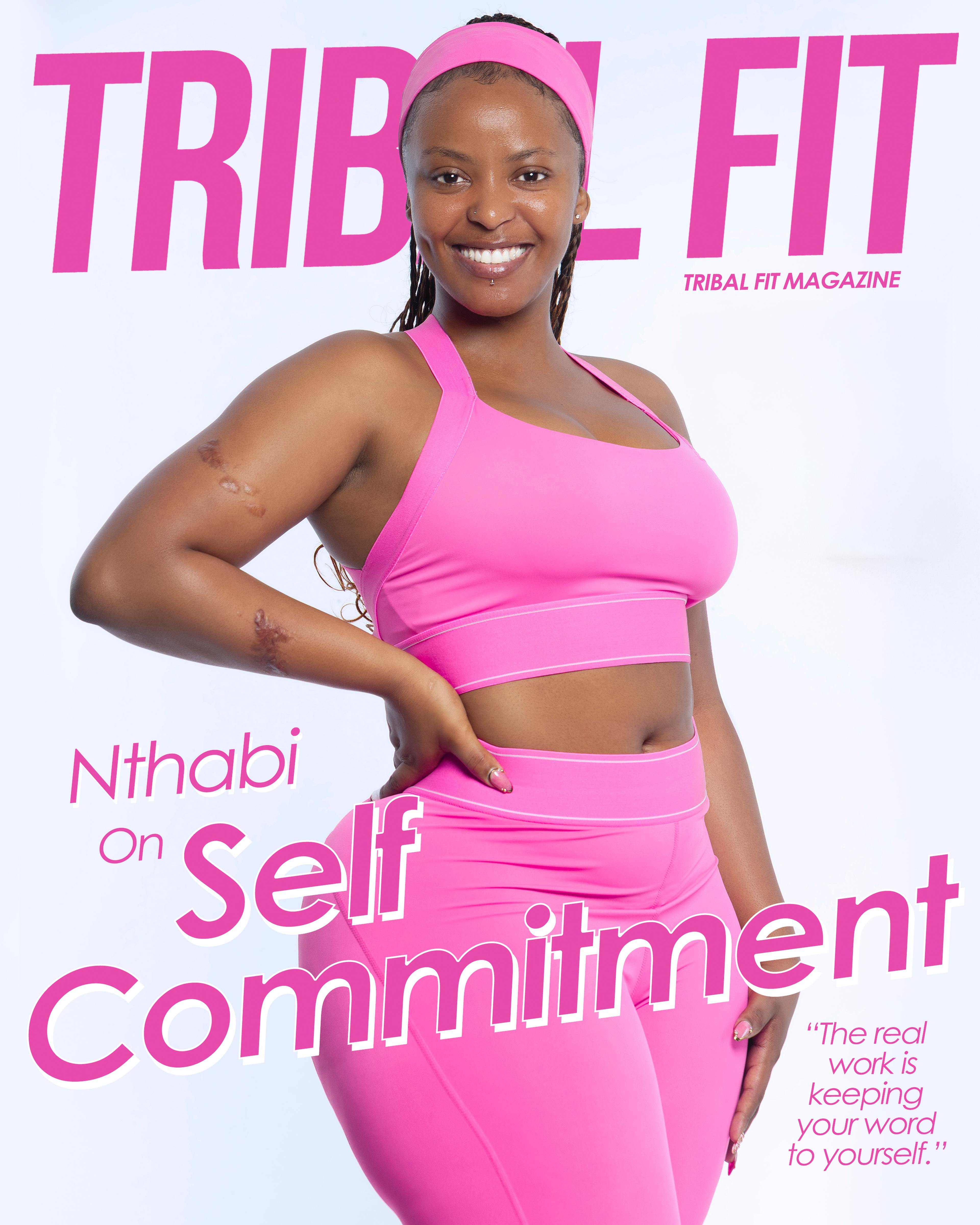

The Admission
Every commitment story has a moment of honesty that comes before it, and for Nthabi, that moment was not gentle. "What I had to admit to myself before I could commit is the fact that I was very lazy," she says. "I don't know what I was waiting for."
As a student, she had gone through seasons where her academics fell apart, and in the middle of that decline, she found herself spiraling into a depressive state, convinced that nothing worked. But one day, sitting with herself, she realized something important. She wasn't dumb. The problem was never her capability. "It all boiled down back to me and I was like, it's you, you are the problem, you are lazy, you don't want to show up for yourself, you think that the world owes you something and it does not."
She remembers being at res, crying, praying for one specific academic breakthrough that would not come, asking God why her. And then the question flipped on her. "Why not you? What have you done to deserve that? Nothing."
Blame Was the Old Fuel
Before she chose to commit to herself, Nthabi lived inside a pattern of expectation and blame. If something did not happen, it was because somebody else did not come through. She needed someone or something to be at fault in order to justify how she felt. "It had to be somebody else's fault. I had to find whose fault it was, and it was never my fault."
That pattern showed up even in her earliest attempts at fitness. At 18, she wanted a flat stomach, so she would head to the field after school and work out near the boys practicing soccer. The motivation was surface level and borrowed from other people's opinions of her. As she got older, she realized the deeper issue. She was not working out for herself. She was working out to prove something to someone else, to show them. And that kind of motivation cannot be sustained. "If I don't find a victim or if I don't find who to blame, I can't work out now."
The only reason that ever held up long term was turning the responsibility fully onto herself. "I had to find a consistent mule which was me. I had to say I'm doing this for you, or because of you, because I had to blame myself first for it."
Commitment Through Pain
For Nthabi, commitment is not conditional on how she feels on a given day. "Committing to myself means even after a big loss, I do it anyway because I understand that life moves on. It never waits for you." She describes it plainly. Life does not pause for grief, for injury, or for exhaustion, so neither does she.
Her framework is rooted in faith. "As a man thinketh, so shall he be." She holds onto the belief that whatever she can imagine and commit to internally, she can eventually become externally, and that once the belief is settled, the execution becomes easier. "I do it anyway. Whether I'm injured, whether I am limping, I do it anyway because in here, it's already done for me." Some days that means going to the gym and lying down for five minutes between every set, not because the workout is easy, but because showing up matters more than performing.
The Illusion of Time
One of the most significant shifts in Nthabi's journey came from a book, The Power of Now, and the idea that time as most people imagine it is an illusion. There is no past to return to and no future to arrive in, only now. "If you ever want to do something, you have to do it now, not tomorrow."
She admits she used to lie to herself constantly, convinced she had plenty of time. "I never had time. I had now, and I could not use it wisely." Once that clicked, everything changed. She did not wait for a better moment. She started as soon as she understood the lesson.
Trying Versus Committing
Nthabi draws a clear line between the version of herself that merely tries and the version that fully commits. The one who tries still believes there is always tomorrow, so she paces herself, takes breaks, and tells herself she will finish later. The one who commits understands there is only now, and acts accordingly. "She's like, I want to finish what I got to do. I got to do what I got to do right now."
That distinction, more than any workout plan, is what changed the trajectory of her consistency.
What She Learned About Herself
The first time Nthabi stayed consistent longer than she ever had before, she discovered something she did not expect. She actually loves commitment. Having something to focus on makes her feel more energized, more alive, more like everything finally makes sense.
Her advice to every woman reading this is simple and direct. Commit to your body, your mind, and your overall wellbeing, because how you see yourself matters more than how anyone else sees you. "It matters to you who you are more than it matters to anybody who you are."
Steady Becoming
Nthabi's closing philosophy is built around a single, powerful idea: you are always becoming, and you never stop. She challenges anyone reading this to imagine themselves ten years from now and ask honestly whether they are okay with who they are today. If the answer is no, that is not a failure. That is an opportunity.
She believes deeply that imagination paired with faith can shape reality. If you can see it and believe it enough, you can become it. So the real question is simple. Who do you want to be? What time does she wake up? How does she move through her day? Then become her, one action at a time.
Her final message carries no cushioning and no delay. You are never too old, too young, too ready, or too confident, because that readiness only ever arrives after you begin, never before. "You don't have tomorrow. You don't have in the future right now. Just start."


Be the first to share your thoughts.