
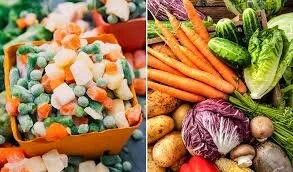
What's the difference between fresh & frozen veggies. We answer the question and tell you all you need to know about this essential and nutritional topic.
Frozen vegetables vs. fresh: Which are more nutritious?
The prevailing belief is that uncooked, fresh produce is more nutritious than frozen… yet that’s not necessarily true.
One recent study compared fresh and frozen produce and the experts found no real differences in nutrient content., In fact, the study showed that fresh produce scored worse than frozen after 5 days in the fridge.
Scratching your head yet? It turns out that fresh produces loses nutrients when refrigerated for too long.
To add to the confusion, slight differences in nutrients may depend on the type of veggies you buy. In another recent study, fresh peas had more riboflavin than frozen ones, but frozen broccoli had more of this B vitamin than fresh ones.
Researchers also found that frozen corn, blueberries, and green beans all had more vitamin C than their fresh equivalents.
Why fresh produce has nutrient loss
The farm-to-store process may be to blame for the nutrient loss in fresh veggies. The freshness of tomato or strawberry isn’t measured from when it hits the grocery store shelf — it begins right after harvesting.
Once a fruit or veggie is picked, it begins to release heat and lose water (a process called respiration), impacting its nutritional quality.
Then, pest-controlling sprays, transportation, handling, and plain old’ time cause fresh produce to lose some of its original nutrients by the time it reaches the store.
The longer you keep produce, the more nutrition you lose. Those bagged salad greens, for example, lose up to 86 percent of their vitamin C after 10 days in the fridge.
How to keep fresh produce nutritious
To maintain the most nutrients, keep these veggies in the crisper drawer of your fridge:
-
apples
-
berries
-
broccoli
-
carrots
-
eggplant
-
peppers
-
salad greens
Feel free to keep these on the counter:
-
hot peppers
-
oranges
-
melons
-
pumpkins
-
winter squash
-
sweet potatoes
As a rule of thumb, it’s best to keep this group in a cool, dry place:
-
bananas
-
garlic
-
lemons
-
onions
-
potatoes
-
tomatoes
How to freeze fresh produce
How long produce stays fresh varies. Generally, you don’t want to hold on to it for more than a few days before eating it or putting it in the freezer.
The blanch-and-freeze method is a popular one to deactivate the enzymes that cause fruits and veggies to lose color, flavor, and nutrients.
Before blanching (i.e., dropping produce into boiling hot water for a few minutes before drying), be sure to look up cooking times, because each type of vegetable is different.
Foods that are best frozen are those with high amounts of fat-soluble nutrients, like vitamin A (broccoli), carotenoids (carrots), and vitamin E (spinach and kale). They’re more stable during food processing and storage.
What about cooked vegetables?
Sorry, raw foodies. The bag is still mixed on whether cooked veggies are “worse” nutritionally. How you cook these foods may be the deciding factor.
According to the research, steaming is the best way to preserve the nutrients in many foods, like broccoli. This cooking method boosts levels of antioxidants, B vitamins, and phytochemicals like carotenoids.
For others, like potatoes and peas, boiling is the ideal way to keep folate levels high.
In general, the best bet to get the most nutrients is to go easy on the temperature and cooking time. Also, limit the amount of water you use for cooking veggies loaded with vitamins B and C.
Remember: water-soluble vitamins will vanish in the presence of H2O.
Click here to purchase the one tribe training videos guide for R80
Let us know what you think of this feature by leaving a comment in the comment section below and read more about healthy eating here https://greatist.com/